The story of King Arthur is one of the best known in English history: he was the boy who was schooled by Merlin and who claimed his right to lead the Britons against the Saxons by drawing a sword from a stone; later, he was the warrior who congregated with his knights around a Round Table and who was given a magical sword, Excalibur, by the Lady of the Lake.
These stories have been told and re-told hundreds of times – and over the centuries the actual figure of Arthur has retreated into obscurity, with many scholars suggesting that he was a mythical figure who never actually existed.
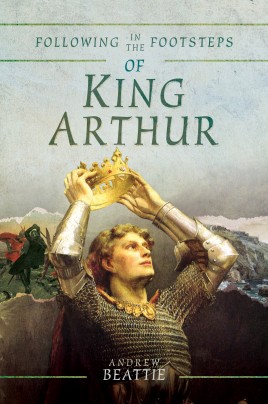
King Arthur has been the subject of thousands of books; yet this one tells his story in a way that is wholly new – through the places where the events surrounding his life supposedly unfolded. From Tintagel Castle in Cornwall, Arthur’s reputed place of birth, to Slaughterbridge in the same county, one of the contenders for the location of his final battle against the Saxons, and from Cadbury Castle in Somerset, one of the numerous claimants to be the site of Arthur’s fort of Camelot, to Glastonbury, where in 1191 his grave was reputedly discovered by local monks, the trail through some of England’s most historic places throws a whole new light on this most compelling of legends. Places in Continental Europe are also discussed in the book. One is the Paimpont Forest in Brittany, the focal point of legends associated with Arthur and Merlin in France, while another is the town of Podstrana, on the coast of Croatia near the port of Split. This was once the home town of a Roman commander named Lucius Artorius Castus, who was posted to York for part of his career and who also fought in Gaul: some have suggested his military exploits in France formed the kernel of the King Arthur legend.
The book is published by Pen and Sword Books; the links below take you to the relevant pages on Amazon and on the publisher’s website. Click here to see a gallery of photos taken during the book’s research.